JavaScript Operators.
(30 Days Of JavaScript)

Passionate about crafting elegant code and building innovative solutions that make a positive impact. 🚀 Join me on a journey through the realms of technology as I share my experiences, insights, and latest discoveries. 💡 Let's dive into the world of software engineering, development trends, and emerging technologies together. Follow along for a dose of tech inspiration and knowledge.
An Expression is a special kind of statement that evaluates to a value. Every expression is composed of -
Operands: Represents the data.
Operator: Defines how the operands will be processed to produce a value.
Consider the following expressions 2+3. Here in the expression, 2 and 3 are operands and the symbol + (plus) is the operator. JavaScript supports the following types of operators.
Arithmetic Operators
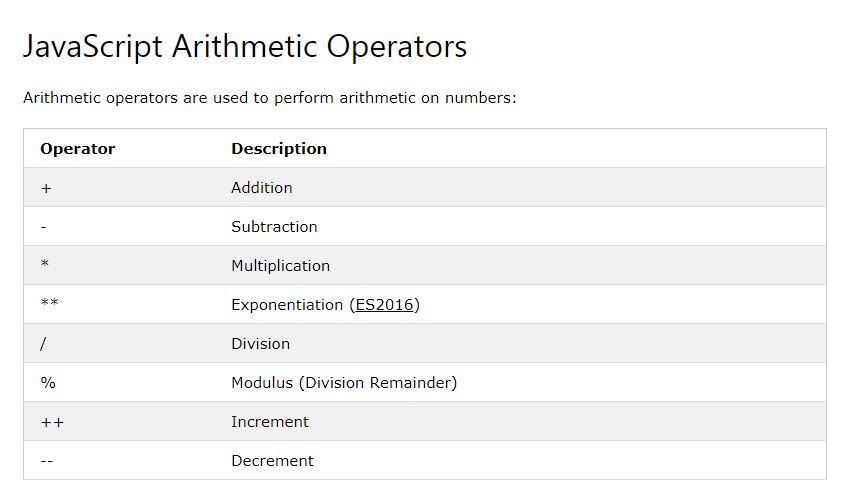
Relational Operators Relational Operators test or define the kind of relationship between two entities. Relational Operators return a boolean value, i.e true or false.
Assume the value of A is 10 and B is 20.
![Screenshot_20210528-142341[1].png](https://cdn.hashnode.com/res/hashnode/image/upload/v1622208313095/GVcn-IHDh.png)
Logical Operators
Logical operators are used to combine two or more conditions. Logical operators, too return a Boolean Value. Assume the value of variable A is 10 and B is 20.
![Screenshot_20210528-142734[1].png](https://cdn.hashnode.com/res/hashnode/image/upload/v1622208558568/AW4GM7o-8.png)
Bitwise Operators
JavaScript supports the following bitwise operators. The following table summarizes JavaScript's bitwise operators.
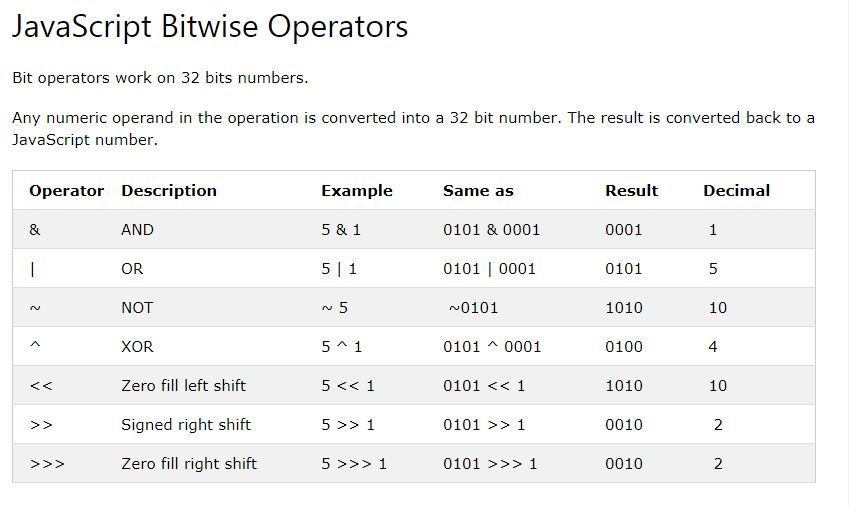
Assignment Operators
The following table summarizes assignment operators.
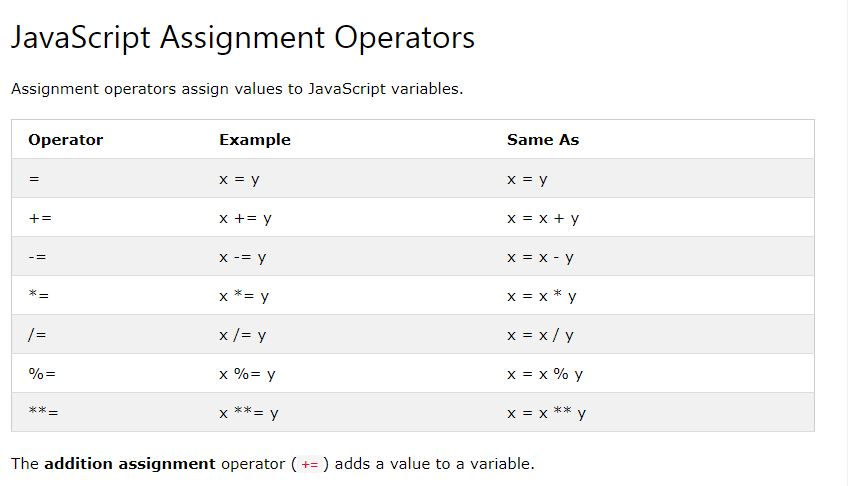
Note- The same logic applies to bitwise operators, so they will become <<=, >>=,>>=, &=, |= and ^=.
Miscellaneous Operators
Following are some of the miscellaneous operators.
The negation operator(-)
Changes the sign of a value. The following program is an example of the same.
var x = 4
var y = -x;
console.log("value of x:  ",x); //outputs 4
console.log("value of y:  ",y); //outputs -4
The following output is displayed on successful execution of the above program.
value of x:  4
value of y:  -4
String operators: Concatenation operator(+)
The + operator when applied to strings appends the second string to the first. The following program help to understand this concept.
var msg = "hello"+"world"
console.log(msg)
The following output is displayed on successful execution of the above program.
helloworld
The concatenation operation doesn't add a space between the strings. Multiple strings can be concatenated in a single statement.
Conditional Operator (?)
This operator is used to represent a conditional expression. The conditional operator is also sometimes referred to as the ternary operator. Following is the syntax
test ? expr1 : expr2
where, Test - refers to the conditional statement.
expr1 - value returned if the condition is true.
expr2 - value returned if the condition is false.
Example:
var num = -2
var result = num >
0 ?"positive" : "non-positive"
console.log(result)
Line 2 checks whether the value in the variable num is greater than zero. if num is set to a value greater than zero, it returns the string "positive" else a "non-positive" string is returned.
The following output is displayed on successful execution of the above program.
non-positive
Type Operators
typeof operator
It is a unary operator. This operator returns the data type of the operand. The following table lists the data types and the values returned by the typeof operator in JavaScript.
![Screenshot_20210528-144856[1].png](https://cdn.hashnode.com/res/hashnode/image/upload/v1622210171555/91qA8bOrp.png)
The following example code displays the number as the output.
var num = 12
console.log(typeof num); //output: number
The following output is displayed on successful execution of the above code.
number